
Two real builds
Puzzle Garden and Moonrail, from input to outcome.
Puzzle Garden: an undo that remembers
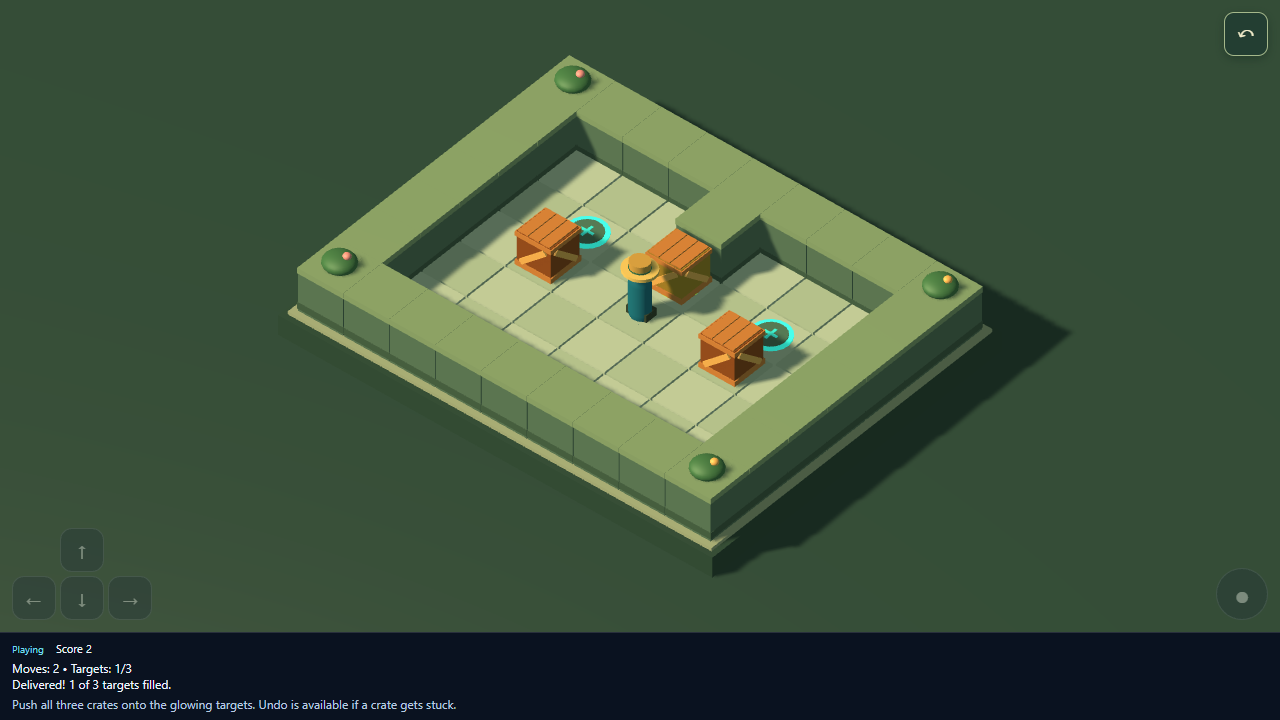
A small isometric 3D box puzzle became a useful test of structural editing: add reversible moves while preserving the original level.
Input · one precise puzzle
Create a 3D Sokoban puzzle on this 9 × 7 map with exactly three wooden crates and three glowing targets. Use discrete grid movement, walls, touch controls, and a counter of valid moves. Win when all crates are on targets. Keep the same movement directions regardless of the isometric camera.
Change · undo the whole move
Add undo with Q and an Undo button, restoring the player, crates, move counter, targets, and victory state. Blocked attempts must not enter history. Add R to restart and clear history. Allow undo after victory. Preserve the map, starting positions, camera, and win condition.
Result · state restored, level preserved
Desktop play reached victory in 12 moves with all three targets filled. Undo after victory returned to 11 moves and two filled targets; repeating the final move won again. Restart cleared the history. The original revision and its publication stayed available.
The public game is presented in English, with its original saved versions preserved.
Built and edited with GPT-6.1 SOL · High reasoning. Desktop gameplay and mobile touch controls were tested.
3 / 3 targets
2 / 3 targets
Recorded Puzzle Garden R2 behavior. The final crate and player return to their previous positions; repeating the move wins again.
Moonrail Harbor: make the jump feel right
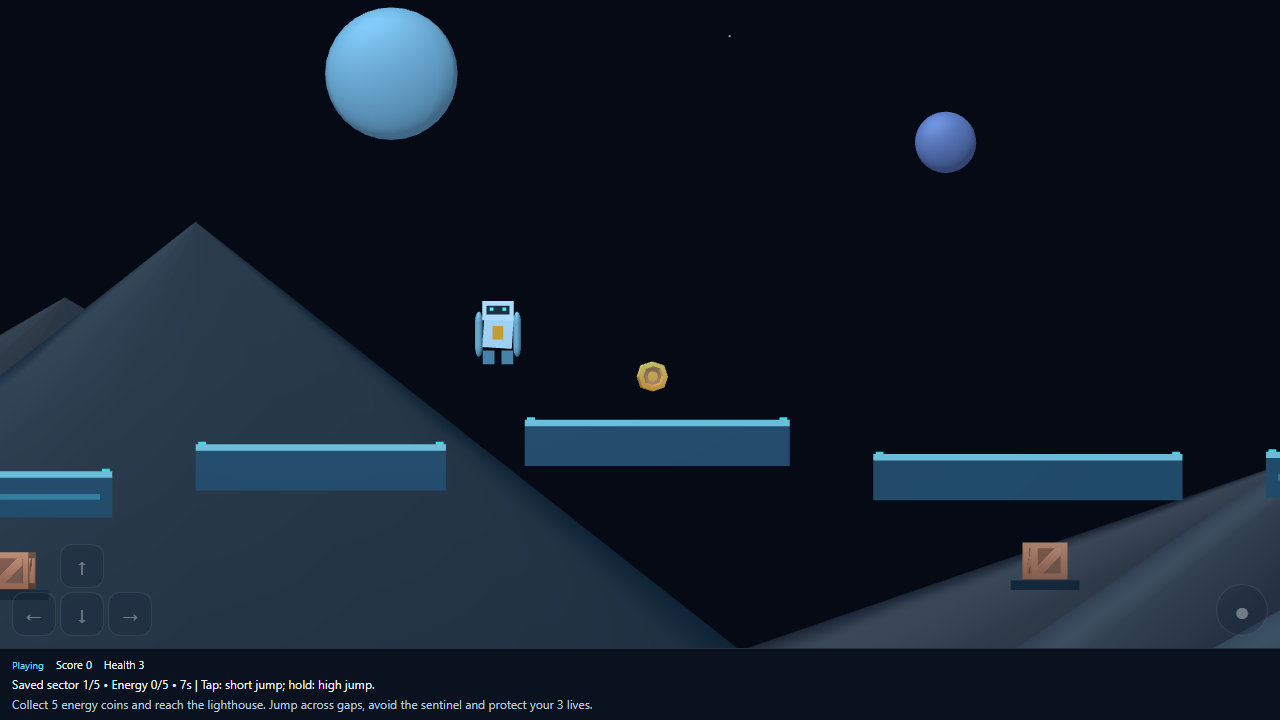
A short 2.5D platformer uses 3D geometry with movement on a side-on plane. A robot collects five energy coins across a lunar harbor and lights the final lighthouse.
Input · a complete, readable route
Build a lunar harbor with five sectors, a steady side camera, three lives, five energy coins, safe checkpoints, and a visible patrolling enemy. Win only at the lighthouse with all five coins. Use the real kenney-coin and kenney-crate catalog models. Support keyboard and simultaneous direction + action touch input.
Change · short press, short jump
A short press and a held press both reach about 1.73 units. Add variable jump height: a brief press should reach about 0.8–1.0 units; holding should preserve the current maximum height and reach. Keep all 20 platforms, checkpoints, enemy, coins, camera, and assets unchanged.
Result · a measurable control change
Measured native keyboard inputs in R1 reached about 1.73 units with both short and held presses. In R2, the short jump reached 0.993 units and the held jump 1.722. Playtesting completed the route with all five coins. The platform geometry and catalog models were preserved.
A third request translated the visible game text into English while preserving the mechanics. The English version retained the variable jump, safe checkpoints, five-coin objective, and restart behavior.
Built and edited with GPT-6.1 SOL · High reasoning. Tested in desktop browsers and mobile touch emulation.
Moonrail R2 · recorded keyboard jump peaks
Height in game units. Bars compare measured peaks; they do not represent recorded flight trajectories.
What to take into your own build
Start with rules that can be tested. Play before editing. Ask for one meaningful change and explicitly preserve the rest. Check both the new revision and the old shared link. Use these builds as examples of what to ask for and what to check in your own game.
Both games are free to play. Their tokens are optional; buying one is not part of the gameplay.